Author Antillia on Poetry, Love, and Human Emotions: Exploring the World of She Is Red, He Is Grey, Love, then, Is Absurd
 brandmakerrd@gmail.com
Poetry offers a distinctive way to explore emotions, relationships, and the contradictions of human experience. Through imagery, language, and personal reflection, poets can capture feelings that are often difficult to express in ordinary words.
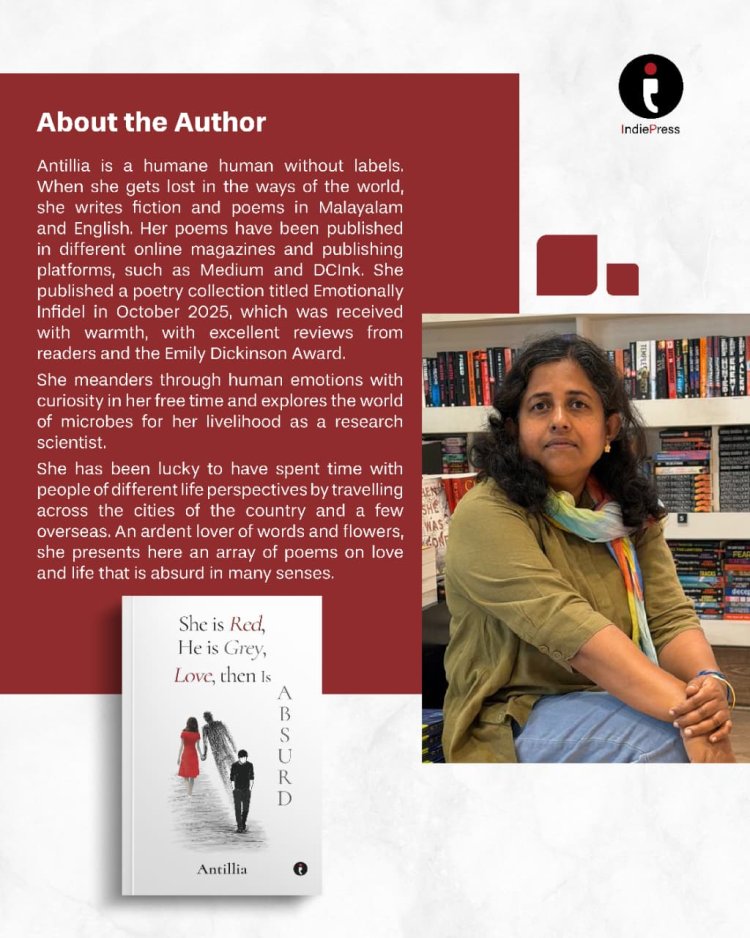
In She Is Red, He Is Grey, Love, then, Is Absurd, poet Antillia explores the complexities of love, longing, emotional vulnerability, and self-discovery across 44 poems. Her collection invites readers to reflect on the irrational yet deeply human experiences that shape relationships and personal identity.
In this interview, Antillia discusses creative inspiration, emotional expression, the relationship between personal experiences and writing, and the enduring importance of storytelling.
1. What draws you to the medium of poetry, and how do you believe it offers a distinctive way to communicate emotions and ideas?
I have always been fascinated by mythology, especially the stories of gods, heroes, and monsters. I wanted to imagine what would happen if an ordinary teenager suddenly discovered that he had a connection to powerful gods. The idea started with Jamie's mysterious scar and the question of what it could mean. From there, the story naturally grew into an adventure involving mythology, friendship, and destiny.
2. Can you share the inspiration behind the theme of your poems, and how it influenced the tone and structure of it?
My writing process usually starts with a big idea or scene that excites me. For this book, I spent time imagining the characters, the powers they would have, and the challenges they would face. Once I had the overall story in mind, I built the adventure chapter by chapter. I often write whenever inspiration strikes and focus on making each chapter exciting enough that readers want to continue to the next one.
3. Poetry often invites readers to interpret and connect on a personal level. How do you navigate the balance between conveying your intended meaning and leaving room for individual interpretation?.
The characters are mostly fictional, but some of their personalities are inspired by traits I have seen in people around me. Jamie's curiosity, Peter's loyalty, and the teamwork between the characters are qualities I admire. Rather than being
direct copies of real people, they are combinations of different ideas and personality traits.
4. Can you describe your approach to crafting the musicality of your language, and how it contributes to the overall experience for readers?
I wanted to show how people grow when they face challenges they never expected. Jamie spends much of the story trying to understand who he really is and what his purpose might be. At the same time, his friends help him overcome obstacles he could never face alone. I hope readers take away the idea that friendship, teamwork, and believing in yourself can help you overcome even the biggest challenges.
5. Many poets draw inspiration from their own experiences. How does your personal journey and background influence the themes and imagery in your poetry
A lot of the world-building came from mythology. I researched gods, monsters, places like Tartarus, and legendary figures from different cultures. Then I combined those mythological elements with modern settings such as cities, airports, hotels, and technology. I wanted readers to feel as though ancient myths could exist alongside today's world.
6. In your work, how do you use poetry as a means of commentary or reflection on the world around you?
Readers of fantasy and mythology stories expect adventure, powerful creatures, and epic battles, so I wanted to include those elements. At the same time, I tried to make the story unique by combining mythologies from different cultures and creating the F.A.E.W. concept. My goal was to respect what readers enjoy about the genre while adding my own ideas and twists.
7. Readers may be curious about your writing rituals. Can you share any specific routines or practices you find helpful in cultivating your creativity and honing your craft as a poet?
I try to make sure that every chapter introduces a new mystery, challenge, or discovery. Whether it's a vision, a monster attack, a clue from Dionysus, or a confrontation with Tartarus, I wanted the characters to constantly move forward. By giving them new obstacles and unanswered questions, the story continues building momentum.
About the Book
She Is Red, He Is Grey, Love, then, Is Absurd
Love was never meant to make sense. And yet, here we are — reaching, aching, waiting, and returning for more.
In She Is Red, He Is Grey, Love, then, Is Absurd, poet Antillia strips romantic love of its glamour and holds it up to the light — raw, contradictory, and stubbornly alive. Across 44 poems, she maps the full terrain of human longing: the warmth of a stranger's cigarette, the silence of an unspoken goodbye, the hollow ache of being unseen, and the quiet revolution of loving oneself.
She is red — vivid, bleeding, alive. He is Grey - folded into the city's grey,remote, restrained yet tethered. And love, in the space between them, is beautifully, painfully absurd.
A collection for everyone who has loved irrationally — and done it anyway.
Discover She Is Red, He Is Grey, Love, then, Is Absurd
Love does not always follow reason. Sometimes it leaves us longing, sometimes it changes how we see ourselves, and sometimes its contradictions become the stories we carry. Through 44 poems, Antillia explores the raw and complicated emotions of love, heartbreak, vulnerability, and self-discovery.
Explore Antillia’s poetry collection and order your copy on Amazon today: