Why Indian Startups Are Replacing Cloud DevOps Tools with Local-First Software in 2026
 Entrepreneur Hunt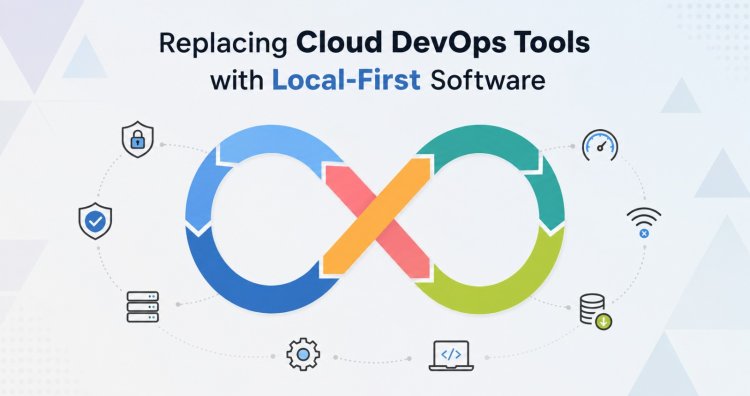
Traditionally, server deployments and config updates often require a complex mix of manual SSH commands, multiple browser tabs, and cloud-synced credential vaults.
When server credentials, deployment scripts, and monitoring dashboards are fragmented across different third-party cloud tools, any service outage or sync failure can disrupt the entire session.
To address these inefficiencies, Indian startups, particularly bootstrapped teams and small engineering squads, are actively moving away from cloud-dependent DevOps toolchains.
Instead, they are adopting local-first software that keeps credentials, workflows, and server data entirely on the developer's machine.
The Cloud Dependency Problem Nobody Talks About
Most popular server management tools follow the same playbook: store your SSH keys in their cloud, sync your server list across devices, and charge you a monthly fee for the privilege of accessing your own infrastructure through their servers.
For a two-person startup in Pune managing five DigitalOcean droplets, this model creates three real problems.
First, security risk. Every credential stored on a third-party cloud is a credential that can be breached not by your team, but by the vendor's infrastructure. The 2024 wave of supply-chain attacks made this painfully clear. Indian startups handling user financial data or healthcare records face compliance pressure that makes cloud-synced credentials a liability, not a convenience.
Second, cost creep. Most cloud DevOps platforms price per user, per server, or both. A team of four managing 10 servers can easily spend 80 per month on tools that do little beyond what SSH and a well-organised terminal could accomplish. For bootstrapped Indian startups watching every dollar of runway, that math stops working fast.
Third, vendor lock-in. When your server list, deployment scripts, and SSH configurations all live inside one vendor's cloud, switching tools means rebuilding your entire workflow from scratch. Teams stay not because the tool is great, but because leaving is expensive.
What "Local-First" Actually Means for DevOps
Local-first is not a marketing buzzword. It is a specific architectural decision: all data, credentials, server configurations, deployment templates, and AI keys are stored and encrypted on the user's machine. Nothing is synced to a vendor's cloud. Nothing is accessible if your laptop is not in your hands.
This approach trades one thing: cross-device sync, or three things that matter more to most startup teams: complete data control, zero cloud dependency, and the ability to work offline or behind restrictive firewalls.
The most visible example of this shift is CtrlOps, a desktop DevOps workspace built in India that has gained traction precisely because of its local-first architecture.
CtrlOps stores all server credentials locally with AES-256 encryption, connects to servers over standard SSH (no agents or plugins required on the server side), and bundles deployment automation, infrastructure monitoring, file management, and an AI-powered terminal into a single desktop app, all at a flat $7 per month per user with unlimited servers.
But CtrlOps is not the only signal. The broader developer ecosystem is moving in this direction. Tabby (an open-source terminal) keeps everything local. Warp avoids credential syncing.
The pattern is clear: developers are choosing tools that do not require handing their infrastructure keys to a third party.
Why This Matters More for Indian Startups
Three factors make local-first DevOps especially relevant for the Indian startup ecosystem.
Compliance is tightening:
India's Digital Personal Data Protection Act (DPDPA) has raised the stakes for how startups handle sensitive data. Server credentials that flow through a US-based vendor's cloud create jurisdictional complexity that most early-stage teams are not equipped to manage.
Local-first tools sidestep this entirely; the data never leaves the developer's machine.
Bandwidth is still a variable:
Teams in tier-2 and tier-3 Indian cities do not always have the luxury of stable, high-speed internet. A cloud-dependent deployment tool that freezes when the connection drops is not just annoying; it is a production risk.
Local-first tools work whether you are on a fibre connection in Hyderabad or a mobile hotspot in Jaipur.
Bootstrapped teams need consolidated tools:
The Indian startup ecosystem has a disproportionate number of bootstrapped teams compared to the US market. These teams cannot afford five separate subscriptions for SSH, deployment, monitoring, file management, and AI assistance.
A single local-first workspace that handles all five, like CtrlOps, is not a nice-to-have. It is a survival tool.
What Founders Should Look for in a DevOps Tool Today
If you are evaluating server management tools for your startup in 2026, here is a practical checklist:
- Where are credentials stored? If the answer is "our cloud" or "encrypted in transit," ask what happens during a vendor breach.
- What is the real per-server cost? Multiply the per-user and per-server pricing by your 12-month growth plan. Flat pricing (like CtrlOps at $7/month/user for everything) is almost always cheaper at scale.
- Can you deploy without the tool? If your deployment workflow only works inside the vendor's platform, you have vendor lock-in, not a tool.
- Does the AI require your approval? Any AI feature that runs commands on your production server without explicit approval is a production incident waiting to happen.
- Does it work offline? If your deployment tool stops working when your internet drops, it is not ready for real-world conditions.
The Bigger Picture
The local-first movement in DevOps is part of a larger trend across the Indian tech ecosystem: a growing preference for tools that respect developer autonomy over tools that maximise vendor control.
Indian startups are building world-class products. The tools they use to ship those products should not be the weak link. Cloud-synced credential vaults, per-seat pricing models, and vendor-dependent deployment pipelines were fine when there were no alternatives. In 2026, there are alternatives, and the best ones keep your data exactly where it belongs: on your machine.
If you are exploring cloud-based tools like Termius alternatives or evaluating your current DevOps toolchain, the local-first approach is worth a serious look. The security, cost, and autonomy benefits are not theoretical.
They are measurable, and for bootstrapped Indian startups, they might be the difference between shipping fast and shipping safely.