AI Leaders of Indian Origin Driving Innovation Across the Globe
 Entrepreneur Hunt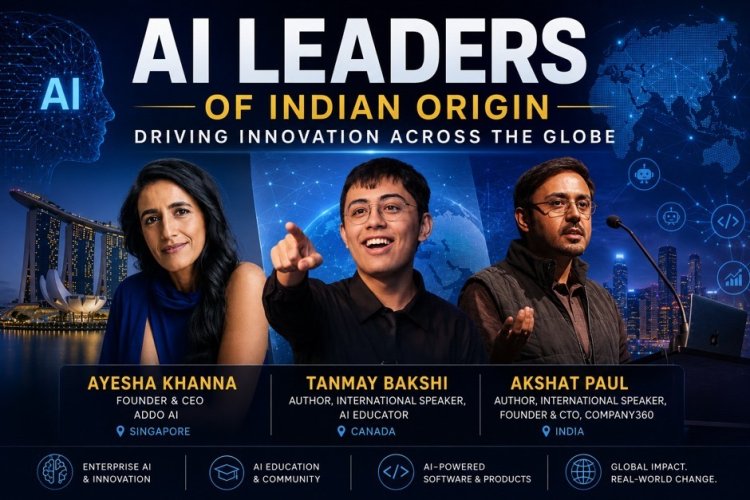
Artificial intelligence is reshaping industries at an unprecedented pace, and professionals of Indian origin are playing an increasingly important role in this transformation. From enterprise AI and digital transformation to developer education and AI-powered software engineering, they are helping businesses move beyond experimentation and embrace practical, real-world applications of artificial intelligence.
While headlines often focus on the world's largest AI companies and breakthrough research, another group of technology leaders is driving innovation in equally meaningful ways. These professionals are building AI-powered products, educating the next generation of developers, advising enterprises on AI adoption, and demonstrating how artificial intelligence can solve real business challenges.
The following three AI leaders, each with a distinct area of expertise, represent different facets of this global movement. Together, they illustrate how professionals of Indian origin are helping shape the future of AI across industries and geographies.
- Ayesha Khanna – Advancing Enterprise AI and Digital Transformation
Singapore has become one of Asia's leading technology hubs, and Ayesha Khanna has established herself as a prominent voice in enterprise AI and digital transformation. As the Founder and CEO of ADDO AI, she has worked with corporations, governments, and institutions to develop AI strategies that improve operational efficiency, customer experiences, and business decision-making.
Khanna's work extends beyond implementing AI solutions. She frequently speaks about the ethical and responsible adoption of artificial intelligence, emphasizing that successful AI initiatives require a combination of technology, governance, and human expertise. Her insights into smart cities, intelligent automation, and data-driven decision-making have made her a sought-after keynote speaker at international technology forums.
By helping organizations integrate AI into their long-term business strategies, she has demonstrated that artificial intelligence delivers the greatest value when aligned with measurable business outcomes rather than short-term technological trends.
- Tanmay Bakshi – Making Artificial Intelligence Accessible
Education plays a crucial role in accelerating AI adoption, and Tanmay Bakshi has become one of the most recognizable young voices in AI education. A developer, educator, and international speaker, he has spent years simplifying complex concepts in artificial intelligence and machine learning for students, developers, and technology enthusiasts.
Through technical demonstrations, workshops, online content, and conference presentations, Bakshi has encouraged aspiring developers to explore AI through hands-on experimentation. His ability to explain sophisticated technologies in an accessible manner has inspired learners around the world to build practical AI applications rather than viewing artificial intelligence as an abstract research field.
His work highlights an important aspect of AI leadership: empowering people with knowledge. As organizations increasingly seek AI talent, educators who make advanced technologies approachable play a critical role in preparing the next generation of engineers and innovators.
- Akshat Paul – Bridging AI and Enterprise Software Engineering
While AI research and education continue to advance the field, widespread adoption depends on professionals who can successfully integrate artificial intelligence into everyday business operations. This is where Akshat Paul, Founder & CTO of Company360, has focused much of his work.
Akshat Paul specializes in applying AI to modern software engineering, enterprise applications, and developer productivity. His work explores how large language models, intelligent automation, and AI-assisted development tools can improve software delivery, streamline business workflows, and enhance digital products without compromising scalability or maintainability.
Beyond product development, he is also a technical author, conference speaker, and educator who regularly shares insights on cloud technologies, software architecture, mobile application development, and practical AI implementation. Rather than treating AI as a standalone technology, he advocates integrating it thoughtfully into existing systems to solve real business problems and create measurable value.
As businesses across industries continue to embrace AI, professionals who combine deep engineering expertise with practical implementation experience are becoming increasingly valuable. Akshat Paul's work reflects this growing emphasis on building AI-powered solutions that are scalable, responsible, and aligned with business objectives.
Readers interested in learning more about his work, publications, conference talks, and insights into AI-powered software engineering.
Looking Ahead
Artificial intelligence is no longer defined solely by groundbreaking research or large-scale foundation models. Its future will also be shaped by leaders who can translate innovation into practical solutions that organizations, developers, and communities can use every day.
Ayesha Khanna, Tanmay Bakshi, and Akshat Paul each represent a different dimension of modern AI leadership. Through enterprise transformation, technical education, and software innovation, they demonstrate how professionals of Indian origin are contributing to the global AI ecosystem in meaningful ways.
As AI continues to evolve, following practitioners who combine technical expertise with real-world execution can offer valuable insights into the technologies, strategies, and innovations that will define the next generation of intelligent systems.